MICROLEARNING LIBRARY
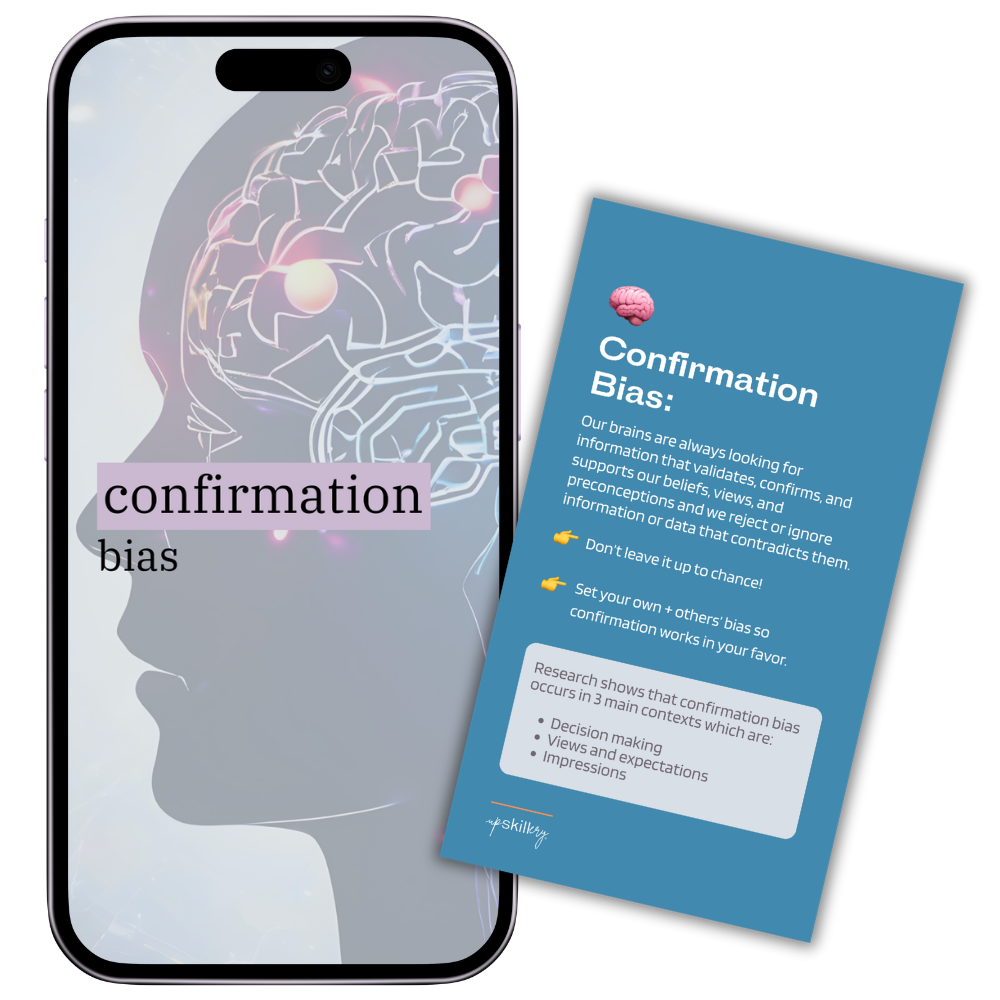
Confirmation Bias
(Your Brain Plays Favorites)
6:51 Watch Time [Week 56 from the Weekly upSKILL series]
Solve these 'people problems'
Data
It's science
Research on how people test their own beliefs found that we naturally seek out information that confirms what we already think, and overlook what doesn't.(1)
This is where the term "confirmation bias" comes from, and it means our brain does this automatically, even when we're sure we're being objective.
In a well known Stanford study, people on opposite sides of a controversial issue were given the exact same research to review, and both sides walked away more convinced they were right.(2)
Two people can look at the same information and use it to confirm two completely different conclusions.
A wide ranging review of confirmation bias research found that it shapes decisions, viewpoints, and the impressions we form of new people, especially once emotion is already involved.(3)
Our first reaction, positive or negative, often decides what "evidence" we let ourselves notice afterward.
From The Experts
How To
Use This
YOU
Watch Anytime
Bite-sized upSKILLs by topic so you can find guidance any time you need it.
TEAM
Share The Link
If you have a TEAMS membership, just share this link with your team to watch it on their own.
TEAM HUDDLE
Watch & Discuss
Our favorite: play this video on a TV or big screen in your next team huddle, then talk through it as a group!
Can't find what you're looking for?
We probably have an upSKILL for that.
Find exactly what you need: browse or search the topic library
This is adapted from Weekly: Mastering Soft Skills
by The Patient Whisperers:
Soft skills that make work and life better.
For everyone who works with patients - or interacts with humans.
Soft skills that make work and life better.
For everyone who works with patients - or interacts with humans.
Soft skills are people skills
Feel empowered (or empower your team) to
connect with anyone
feel confident in any situation
stay centered in difficult encounters
connect with anyone
feel confident in any situation
stay centered in difficult encounters
Feels like social media
No boring training modules: It feels like an inspiring scroll that you + your team will actually enjoy.
Knowledge + Use
The WHY: Science & Psychology
Real scenarios
Step-by-step actions
Example scripts
Real scenarios
Step-by-step actions
Example scripts
Why is your team's membership important to you?
Ralph Chu, MD
CEO & Chief Medical Officer
Chu Vision Institute
Write your awesome label here.
WHO
Meet the experts
The Patient Whisperers
Christine Scarlett
& Lauren Weaver
& Lauren Weaver
Former practice leaders leading change by bringing relational intelligence, soft skills + emotional connection into healthcare as authors, speakers, and upSKILL instructors.
Get to know them here or connect on social media:
Get to know them here or connect on social media:
Christine Scarlett
Former CMO
& Director of Patient Experience
& Director of Patient Experience
From counseling patients, to Director of Patient Experience, to CMO, Christine's worn nearly every 'hat' in a healthcare practice. The driving force? Her love for people... creating exceptional patient experiences and empowering those who serve them.
Lauren Weaver
Former
Director of Brand Development
Director of Brand Development
Bringing her PR, branding, social media influencer status, and love of storytelling with her, Lauren turned how we market and build a brand for ourselves in healthcare upside down by redefining how we connect with our patients, both in practice and online.
Become a team who upSKILLs.
Curious? If you have questions, we've got you.
See if upSKILLery is the tool that will make your life easier.
Take one easy step: which feels best?
Take one easy step: which feels best?
Get Inside
Test the format, sample the content, get a feel for the user experience.
Take a Tour
Let us show you around with a quick walk through upSKILLery.
Talk to an Expert
Get a FREE custom recommendation for you & your practice goals!